Literate videogame journalism

There’s no two ways about it – print, broadcast and online videogame journalism is largely crap bought and paid for by the publishers. Enter The Escapist. If you can get past their retarded ‘we think we’re a print magazine’ website design and its 6pt type (which you don’t dare enlarge since it completely destroys their layout if you do) you’ll find an absolutely superb webzine that regularly updates its content (1 major and one minor update a week) and is written for an adult demographic by adults who aren’t posing as adolescents. A sample from this week’s issue to whet your curiosity, from a piece on the impact of videogames becoming a mainstream medium:

From a cultural analyst’s perspective, it’s almost painful to watch a unique, complex subculture get swallowed up in America’s hegemonic mainstream. Something may be gained, but something will definitely be lost.

Check it out for more. You can sign up via marketing free email, and if you’re so inclined you can download each issue as a pdf instead of reading it on their site.

(And yes, I’m painfully aware of what’s being lost as the transition to mainstream medium has been taking place. I’d say something snarky like ‘all we need to do is destroy EA and their endless sea of sequels,’ but they’re a symptom of the problem, not the problem itself).

Singing the praises of Gregarius

Feeddemon’s unfortunate pairing with Newsgator has left me looking for alternatives. I’ve nothing against the move and am happy for Brad, but I don’t want my data tied to a commercial provider who can opt to change their terms of service, so I’ve been casting about for something else to use. Ironically the issue that drove Feeddemon to partner up with Newsgator was a need for persistent storage of ‘feed state’ – if I read my feeds at work then want to check them again at home, I don’t want to see the same data all over again. Feeddemon turned to Newsgator for a solution to this problem. I’m turning elsewhere. I’ve tried a variety of things, most notably RSSowl, which is really a pretty decent aggregator, but it lacks a couple of features I’ve come to rely on and lacks an elegant ‘feed state’ solution.

Enter gregarius, a php/mysql-based server side RSS aggregator. It’s still in the relatively early stages of development and is a bit rough around the edges, but it’s entirely usable, such that I’ve been using it as my primary aggregator for the last 3 weeks. You can check out my instance of it if you want to play around with a copy (or get a glimpse into where the bulk of the content of this site ultimately comes from, for that matter). You won’t be able to see the administrative back end but you can get a sense of how it works.

It’s somewhat slower than using Feeddemon is, and I still haven’t gotten feed filtering working as I’d like, but at this point I’ve concluded it’s good enough for my daily use. Kudos to the developers for an excellent project (but please, use your devlog! 😉

Musings on the future of FastCGI

This is mostly an uber geeky post for my own uses, though one or two of the folks who stop by here might find it interesting. The musings aren’t mine, they’re vmunix’s, and they’re excellent. I’ve been spending a lot of time thinking about current best of breed we app development environments, for reasons I hope to be able to talk about in a week or two. Today I happened across vmunix’s post, which is a discussion of where the future of FastCGI, SCGI and apache may lie. This is a huge issue in that mostly what I’ve been concluding is that the new MVC frameworks that have emerged over the last year are really the way to go, but deployment of apps based on these frameworks is hampered by their poor integration with apache/2. The question then is what to do, and the answers are less than satisfying. The rails camp, for example, will basically tell you to switch to lighthttpd. I’ve got nothing against lighthttpd in principle (and really it gets great reviews all around) but I have over a decade invested in apache and an attendant nest of code tied to it, so switching isn’t a trivial undertaking and the payoff has to be worth the investment it would take to migrate everything. I’m not convinced it is. Vmlinux’s take is that ultimately either fastcgi or scgi will become a core apache module in the same way that mod_php did, but he also makes the observation that it might make more sense to simply use mod_proxy and proxy requests from apache to a distinct webapp server, taking his cues from how the Java and Zope camps ended up where they are. This is excellent stuff and well worth a read for anyone managing web services or curious about where things are potentially headed.

As to my own conclusions on the subject, I have nothing firm yet. The contention is it’s easier to manage distinct app servers (an instance of lighthttpd with fastcgi for rails apps, with mod_proxy pushing requests over from apache, for example) than it is to build the one apache binary to fit them all. I’ve felt that pain of complex apache recompiles and seemingly irreconcilable dependencies so I know from whence this comes, but I also get leery of this conglomeration of configuration files you’ll then be left managing, such that when an app breaks down you wander around in the disk trying to figure out where the fault is. The bottom line is I need to get some hands on time with a configuration just like this, actually put my hands on it, before I draw any firm conclusions, as well as bounce it off a couple of folks whose opinions I value.

allofmp3.com gets it

Finally, someone seems to have a rational approach to online music distribution. Allofmp3.com allows you to buy tracks in a variety of lossless formats (FLAC, Monkey’s Audio, etc etc) and charges a flat rate for the track plus a floating rate based on the size of the generated file you select. For example, say you wanted to buy Sigur Ros’s (). You could buy it encoded to 192kb mp3 for $2.02, or you could buy the album in lossless FLAC for just under $10. The former is great for your mp3 player but not so good if you have a $2500 home theater setup, the latter is good for ALL formats you choose to play your music in. This is pretty much exactly what I have been wishing for. There are only two problems – first, not all albums are available in lossless formats. Second, while at this point in time use of the system in the US appears to be legal, it’s under attack from, you guessed it, the RIAA (as well as their counterparts in other countries and a host of related IP companies and institutions). So how long this lasts remains to be seen.

It’s really really freaking aggravating that the only way to obtain digital music unencumbered by retarded DRM schemes (think they’re not retarded? Name one person on EARTH they’re stopping from obtaining the music! It is so completely trivial to obtain music illegally that grandmoms are doing it!) is by taking advantage of obscure loopholes in foreign country’s copyright laws. I don’t really see a clear way out of this mess. What I do see is, this is how a digital music system ought to work. The pricing is rational, you can actually obtain lossless quality tracks, and the music isn’t mucked up with DRM (grandma can go steal all of frank sinatra’s music off kazaa, or she can buy it off of some other system, then god help her try and figure out how to play it in her car. You tell me which system is better).

I’ll also note allofmp3.com has a 20% off sale through January 14th. I bought the album linked above and had it on my computer about 45 minutes later in lossless flac.

I’ll also observe that if you can listen to Sigur Ros’s:

Takk...

and it doesn’t bring a huge grin to your face, there’s something wrong with you. Beautiful beautiful stuff.

New year’s resolutions

I have two this year, one serious and one rather…oh, frivolous.

On the serious side – over the past several years I’ve been really diligent about getting regular, rigorous physical exercise. This has been fantastic on basically all fronts – I feel better, I never get sick (this Christmas’s episode being literally the only exception in 3+ years now), I sleep better, my digestion is better than it used to be, I’m in fantastic shape, and more. Granted, I got on this kick based on some health issues I had to confront, but all in all I’m really pleased with the results. Amongst other things it’s taught me something about discipline. I had already sort of learned the lesson of the little engine that could when I quit smoking years ago – if I set my mind on something, I know I can do it – but in many ways the physical regimen was more difficult than quitting smoking. I’ve decided to focus on intellectual development this year, bringing to bear the same disciplined approach I’ve taken with physical development.

I’m taking this as my resolution this year because I’ve concluded I spend too much of my time basically consuming mental junkfood. It’s funny – when I first got out of school years ago I forced myself to start working my way through the ‘great works’ of literature. Some of it was fantastic – Nabakov, Tolstoy, Austen, to name a few. Some of it was just dreadful – Plato’s Republic is a seminal work, I grant you, and on some abstract level I want to know it and understand it. But the years after college that I spent forcing myself to read things of that nature ended up taking the enjoyment out of reading. For a period of time centering right around when I moved to Maine I had basically stopped reading, something which those who know me would find surprising given how avid a reader I’ve been. I solved this by turning to mental junkfood, a strategy I’ve generally stuck with for a long time now. When it comes time to read something off my shelf and I have to choose between, say, Dostoevsky’s Crime and Punishment (I cannot tell you how many times I’ve started and abandoned this book) and, say, an illustrated Conan novel, well, over the last decade or more I’ve almost always chosen the latter. Delicious mental junkfood, who can resist! Better to use literature (as you can see I’m using that term loosely) as an escape than as a means of self flagellation.

I actually experimented with trying to be rigorous about my reading choices this year with mixed results – it generally worked when I chose to be disciplined about it, but more often than not, I chose not to be disciplined about it. So, finally we get to the terms of the actual resolution. This year, as with exercise of the body, I’m going to exercise my mind, at a minimum 5 days a week. This will take the form of me working my way through at least one chapter of a technical manual each of those 5 days. No exceptions, no excuses, etc etc. I chose technical manuals rather than literature, at least for now, because I fear spoiling the pleasure of escape that reading affords me, and because generally they’ll more immediately assist me in my work. I’ve already begun and am 5 chapters through Learn to Program, an earlier version of which you can check out yourself. So far it’s going great.

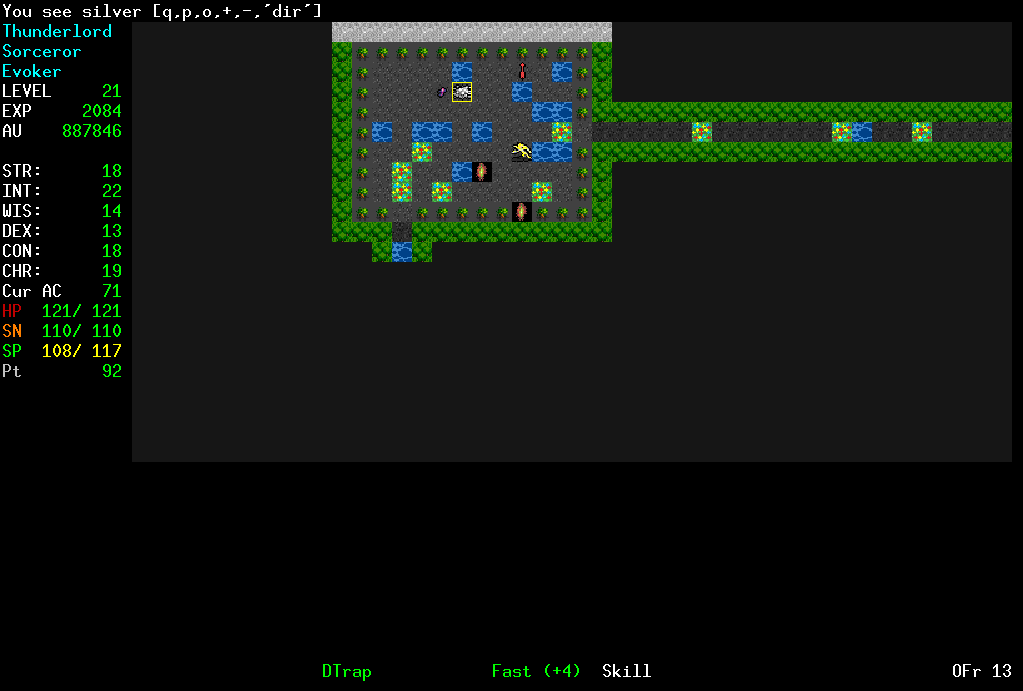
As to the frivolous resolution – I’ve been playing roguelike computer games since college, and really since jr high school with their spiritual antecedents (a perfect example being Dungeon on the Commodore Pet). I’ve probably played Sword of Fargoal a million or more times, including many games in recent years using the remake. And I can’t begin to estimate how many hours I’ve spent running through the seemingly endless dungeons of the pits of angband. Yet out of all that time, I’ve never, once, actually WON a game. So. This year, I’ll beat a roguelike. I’m starting with TOME (troubles of middle earth) version 2.3.3, because currently it’s one of the most well managed roguelikes and is regularly updated and has an extensive player community. For those of you who’ve seen some of the screenshot and think I’m playing an ascii game, I’m not quite that hardcore – this is the graphical mode I’m playing in. It won’t win any awards for visuals, but the exacting tactical combat is a thing of beauty, really, and if you’ve read Tolkein you’re sure to agree that an opportunity to beat down Wormtongue, hordes of orcs and goblins, and untold other minions of Sauron, is an opportunity you simply can’t pass up. I’ll post stat-dumps of my character to my wiki as things progress. I’m already some ways along, hovering around 20th level and having thumped Bullroarer the hobbit, Boldor, King of the Yeeks, as well as his son and a horde of his minions.

See, I told you the second one was somewhat frivolous 😉

Interesting observation about muscle memory

Mainly that mine is pretty damned strong. I drove a saturn for 8-9 years. I’ve been driving a Mazda3 now for about about a year and a half, and I still screw up the windshield wiper controls and the headlights – my muscle memory takes over and I do what I used to do with the Saturn rather than what I ought to be doing for the Mazda. It’s been gradually getting better but I’d still estimate that more than 1/4 of the time, I screw up. Weird huh?

Two games solved, gazillions to go

So aside from laying around sick for most of my vacation, I did manage to accomplish a few other things, mostly before I fell ill. I solved two games, Call of Duty 2 and Gothic II Gold (which includes the Night of the Raven expansion pack). Call of Duty 2 was superb. It brings basically nothing new to the first person shooter table, but it’s consistently entertaining, superbly executed, has excellent graphics, and absolutely fantastic audio. In fact the closest it comes to innovating is in the audio department – it’s the most immersive first person shooter I’ve played and this is largely due to how well done the audio is. It’s quite nerve wracking to play, as your teamates shout in anger or pain, bullets whiz by, things blow up around you, and the screen shakes with the impact of various explosions. The multiplayer is a letdown though – very few maps, spastic bunnyhopping gameplay, and rampant cheating. I barely bothered with it. Highly recommended nonetheless – best shooter I played this year by far.

Gothic II goes down as one of my favorite games of all time. I loved the original and the sequel is more of the same plus better graphics, a longer story, and a much larger area to explore. I got to the end of chapter 5 when the game originally shipped then went through a machine rebuild and lost my savegames due to a snafu during the rebuild. When I started playing the gold edition I wasn’t sure I would be able to play through so much of the content again, but the expansion pack material plus the quality of the game made it if anything more compelling than the first time through. If you’re not familiar with the series, imagine starring in a mediocre quality epic fantasy novel, with full speech for the characters in the game, a somewhat living world (people wake up, go to work, eat, sleep, argue, wander around, remember you if you do them harm or help them), a huge 3d world to explore, arcade combat tied to your character’s statistics, and a variety of skills you can learn (alchemy, different schools of combat and magic, animal skinning, lock picking, plus several others) and enhance over time. The plot won’t win any awards but it’s at least equal to most of what the genre typically offers and it features a nice twist at the end that sets things up for Gothic III, which will ship sometime this year.

If you played the original but not the expansion pak, it’s worth a look. The pak adds another large region to explore, fleshes out several factions, fills in some holes in the plot, and re-balances the combat and experience system to make things more challenging towards the end of the game. An unfortunate consequence of this is that things are much tougher in the beginning.

The game series is consistently criticised for its control scheme. It never bothered me. Maybe it’s because I play so many games and find it easy enough to adapt to a variety of control schemes, but I don’t even get why people complain. It takes less than 10 minutes to adjust and it’s not like it’s complicated – compared to, say, trying to master the control system in something like Tekken 5 or insert your beatemup of choice, it’s trivial. The game is also available for under $20, and you’d be hard pressed to find a better entertainment value. All told I spent almost 40 hours running around inside gothic II’s little world, and I loved almost all of it. Check it out if you’re a fan of fantasy rpgs.

Visualizing the composite human

Well, human face anyway. Check out the faceoftomorrow.com project, where they’ve shot photos of hundreds of women and men from a variety of cities, then processed the images to show what a composite male or female face looks like from any of a dozen or so cities. This is cool, cool stuff. It’s a bit deceptive in that the process of merging the faces smooths out facial features and the texture of folk’s skin, making it look like these cities are peopled with lingerie models, but you can use a flash app to check out the individual faces the composites are comprised of. They haven’t yet posted US cities yet but two are apparently on the way.

TV 2.0 – btseasonpass

Another example of a meme I’ve touched on several times (how RSS and torrents have the potential to replace traditional tv distribution) – btseasonpass.com, a web service that lets you define rules for the torrents you’d like to download, enabling you to grab episodes of tv programs sort of like you would using, say, your tivo. Sign up, develop your viewing rules, and wait for the shows to come in. Registration is free.

If you’re skeptical about the whole notion, I’ll observe: despite having one of the best PVR applications available (beyondtv), I still use mechanisms like this to retrieve video materials because they’re simply more convenient than bothering to configure the PVR, and the shows I get generally come with the added benefit of the advertising already having been stripped out. I watched the last season of Battlestar Galactica and The Shield this way, and I’ll be doing the same for the upcoming season of The Shield as well.

(and a side note to the broadcasters who freak when they hear about the ads being ripped out – what, you were under the impression I was watching your ads? At any point in the last 10 years or more? You lost your audience with the advent of cable and the remote control. Don’t fall into the trap the RIAA is in – find your new business model instead of clinging desperately to your old one).